Feeding a film crew is different from catering a corporate lunch or a wedding reception. Production catering works under a different set of rules, where meal timing is dictated by the shooting schedule, headcounts change daily, dietary needs have a wide range, and a late meal can cost a production thousands of dollars in idle crew time.
Catering companies that serve New York film and television productions understand that efficiency is not a preference on set, it is a contractual requirement. This guide covers how production catering works, what makes it operationally different from standard catering, and what film crews actually need from a catering partner to keep a shoot running on schedule. Alfonso’s Catering has earned a solid reputation by understanding the demands and requirements of production work.
What Is Production Catering?
Hire Us To Cater Your Production!
Production catering is a specialized food service operation that provides on-set meals and craft services to film, television, commercial, and music video crews throughout a production day. It differs from standard event catering in three fundamental ways, service timing, which is dictated by the assistant director’s schedule instead of a fixed clock, food quantities that fluctuate based on daily call sheets, and the kitchen travels to the location, compared to operating from a fixed facility.
Union productions follow SAG-AFTRA and IATSE meal penalty rules, which require a hot meal within six hours of crew call. A missed meal means financial penalties charged directly to the production, so the production caterer’s primary job is to make sure such penalties never happen.
How Does Production Catering Work on a Film Set?
Production catering works in two separate service tracks, catering and craft services, that run simultaneously throughout the production day.
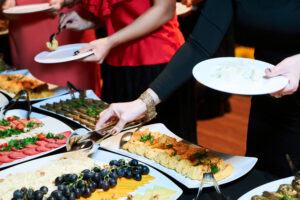
Catering refers to the structured hot meal service, which is served at the six-hour mark from crew call and again if the shoot extends past twelve hours. The catering team sets up a full hot line with multiple protein options, sides, vegetarian and vegan choices, and a salad station. Service windows on union shoots are usually thirty minutes, which means the catering team must serve between 30 and 300 people efficiently in that time frame without compromising food quality.
Craft services run continuously from crew call to wrap. The craft service station keeps the crew fueled between meals with coffee, cold beverages, snacks, fruit, pastries, and quick grab-and-go items available near the set. Craft service is not the same as catering, though many production catering companies in New York provide both under a single contract.
What Makes Film Crew Catering Operationally Different From Regular Catering?
The factors that make film crew catering operationally different from regular catering include location variability, headcount fluctuation, and dietary requirements across large groups. All three require specific infrastructure and experience to manage correctly.
Location Variability
New York productions shoot across all five boroughs, in studio facilities in Queens and Brooklyn, on location in Manhattan streets, in New Jersey warehouse spaces, and in occasional distant locations upstate. A production caterer transports a complete commercial kitchen, which includes generators, cooking equipment, serving stations, and food inventory, to each location. Street parking permits, load-in timing, and generator placement require coordination with the location manager days before the shoot.
Interior studio shoots present a different challenge, as catering teams set up in hallways, loading docks, or adjacent rooms instead of outdoor spaces with truck access. Adaptability to each location’s physical constraints is a baseline requirement for any New York production caterer.
Headcount Fluctuation
A production’s daily headcount changes with the shooting schedule, as background actors added for a crowd scene can double the expected meal count with less than 24 hours notice, while a department wrapping early reduces it. Production caterers build headcount buffers into their prep quantities and maintain flexible inventory to accommodate these changes without running short or generating excessive waste.
The industry standard is to carry 10 to 15 percent over the confirmed headcount on any given day, with menu items that hold well under heat lamps without degrading in texture or appearance over a 30 to 45-minute service window.
Dietary Requirements Across Large Groups
Film and television crews include union members across multiple departments with specific requirements and background performers with their own dietary restrictions. A production caterer serving a crew of 150 people manages vegan, vegetarian, gluten-free, dairy-free, nut allergy, and halal requirements at the same time as standard menu components.
Professionals for the principal cast sometimes specify particular proteins, preparation methods, or meal timing separate from the general crew meal. A catering team with production experience handles these requirements discreetly and without disrupting the main service line.
What Should a Production Catering Menu Include?
A production catering menu should balance quality, variety, and practicality across a full shooting day.
Hot meal service: Hot meal service should include at least two protein options, one of which is always a non-meat choice that functions as a complete entree, not a side dish. Rice or grain bases, roasted vegetables, a composed salad, bread service, and a dessert option cover the basic expectations for union crew meals in New York.
Craft service stations: Craft service stations perform best when they include fresh fruit, mixed nuts, protein bars, cookies or pastries, whole grain crackers, cheese, and a minimum of two coffee options, which include regular and decaf. Seasonal adjustments also matter, as a hot soup station is appealing during a January exterior shoot and cold-pressed juices do the same in July.
Late-night and overtime meals: Late-night and overtime meals are necessary when shoots extend past the second meal window, twelve hours from crew call. These meals tend toward comfort food, as crew members in hour thirteen respond better to pasta, warm sandwiches, or hearty grain bowls than to the lighter menu that works at a midday first meal.
What Does Production Catering Cost for Film Crews in New York?
Production catering pricing in New York is calculated per person per day, which covers both hot meal service and craft services. Production catering rates range from $30 to $75 per person per day, which depends on menu complexity, crew size, location logistics, and whether craft services are included in the contract.
Larger crews reduce the per-person cost because prep and logistics overhead spreads across a higher headcount. Productions running five or more consecutive shoot days negotiate day-rate packages that lower the daily per-person cost compared to single-day bookings.
Additional costs in production catering contracts include location fees for remote shoots that require extended travel, generator rental when facility power is unavailable, and equipment rental for large-format service setups that exceed standard truck inventory.
Why Production Catering Quality Directly Affects Crew Performance
Production catering quality directly affects crew performance, as crew morale and afternoon performance relate directly to lunch quality. A hot, varied, and well-executed meal at the six-hour mark resets the crew’s energy and reduces the friction that develops on a long shooting day.
Productions that cut catering budgets to save money in pre-production often spend more correcting the downstream effects, slower afternoon setups, lower on-set energy, and crew dissatisfaction that spreads through department communication channels. Alfonso’s Catering builds production catering programs for New York film and television crews that treat the meal as a production asset. Reach out to discuss your upcoming production’s catering needs and get a personalized quote for your shoot schedule and crew size.